
Introduction: The Beauty Hidden in the Flaws
Imagine staring at your sketchbook, wishing that crooked line had been straighter or that your paint hadn’t bled outside the edges. Every artist has been there—haunted by the pressure to make everything perfect.
But what if those tiny flaws, unexpected strokes, and happy accidents are exactly what make your art yours?
Perfection might look clean and polished, but imperfection carries soul, emotion, and originality. The most unforgettable art often comes from moments of spontaneity, not precision. From Picasso’s distorted faces to Van Gogh’s uneven brushstrokes—great artists have always known that imperfection is part of the magic.
In this article, we’ll dive deep into why every artist needs to embrace imperfection, how it fuels creativity, and how learning to let go of control can actually make your work more powerful and personal.
The Myth of Perfection in Art
Perfection is often treated like the ultimate goal in art. Artists spend hours adjusting, erasing, and repainting in search of that flawless piece. But perfection is a moving target—the more you chase it, the farther it gets.
The Problem with “Perfect”
Here’s what happens when perfection becomes your main goal:
-
You overthink every brushstroke.
-
You fear making mistakes.
-
You compare your art to others and lose confidence.
-
You stop experimenting.
The truth is, perfection doesn’t exist in art. Art isn’t math—it doesn’t have one right answer. It’s about emotion, meaning, and expression. The moment you stop chasing perfection, you start creating freely.
Real Art Is Human, Not Mechanical
Why Imperfections Make Art Relatable
A perfect painting may look impressive, but it can also feel cold—like it was made by a robot. What people truly connect with are the little details that reveal the artist’s hand, emotion, and journey.
Think about it:
-
A shaky line can show hesitation or energy.
-
A rough texture can add depth and rawness.
-
An uneven tone can create unexpected contrast.
These small imperfections make art alive. They remind viewers that a human being created this—with feelings, mistakes, and passion.
Perfection may impress the mind, but imperfection touches the heart.
Famous Artists Who Celebrated Imperfection
Art history is filled with creators who thrived on breaking the rules and embracing flaws. Let’s look at a few examples:
| Artist | Signature Imperfection | What Made It Special |
|---|---|---|
| Vincent van Gogh | Uneven brushstrokes, bold colors | His paintings vibrate with emotion and energy. |
| Pablo Picasso | Distorted faces and abstract forms | He turned imperfection into a new way of seeing reality. |
| Claude Monet | Blurred details, loose technique | His “Impressionist” style captured light and mood instead of detail. |
| Jackson Pollock | Random drips and splatters | His chaotic canvases became symbols of pure expression. |
| Frida Kahlo | Visible pain, unfiltered honesty | Her self-portraits show real emotion, not polished beauty. |
Each of these artists transformed imperfection into a signature style. Instead of hiding their flaws, they highlighted them—and the world remembered their names.
How Perfectionism Blocks Creativity
The Fear of Mistakes
One of the biggest creativity killers is fear. When you’re scared of doing something “wrong,” you hesitate, doubt yourself, and lose the joy of creating.
In art, mistakes are not failures—they’re lessons. Every smudge, crooked line, or uneven shape teaches you something new about your technique or style.
The Over-Editing Trap
Many digital artists spend hours adjusting colors or symmetry until the life drains out of their piece. The more you polish, the more your art loses its spontaneity.
Perfectionism replaces passion with pressure. It can turn art from a joyful process into a stressful performance.
The Science of Imperfection: How the Brain Loves It
You might be surprised to know that science supports the beauty of imperfection.
The “Wabi-Sabi” Effect
In Japanese philosophy, there’s a concept called Wabi-Sabi, which celebrates beauty in imperfection and transience. A cracked bowl repaired with gold (known as Kintsugi) becomes more valuable because of its flaws.
Psychologists have found that people are naturally drawn to asymmetry and irregularity—they find it more interesting and real. That’s why an imperfect handmade sketch often feels warmer than a perfect computer-generated image.
Brain Reactions to Human Error
Studies show that viewers subconsciously prefer art that shows signs of human touch. Tiny inconsistencies activate empathy and curiosity, making people feel more connected to the artist.
So, imperfections don’t just look good—they feel good to the brain.
Why Artists Should Let Go of Control
Freedom Leads to Discovery
When you stop controlling every detail, you open yourself up to surprises. Sometimes an accidental brushstroke or unexpected color blend becomes the best part of your artwork.
Creativity thrives in chaos and curiosity, not in perfection.
Mistakes Lead to Innovation
Some of the world’s greatest inventions and art movements began as “mistakes.” For example:
-
The Impressionist movement started because artists stopped blending colors smoothly.
-
Abstract art emerged when painters abandoned realistic representation.
-
Many new techniques—like splattering, layering, or collage—were discovered by accident.
By letting go, artists create space for innovation.
How to Embrace Imperfection in Your Own Art
It’s one thing to say “embrace imperfection,” but how do you actually do it? Here are practical tips you can start using today:
1. Set a Time Limit
Give yourself a fixed amount of time to complete a piece. This forces you to focus on the overall feel rather than every tiny detail.
2. Use Nontraditional Tools
Try painting with sponges, credit cards, or even your fingers. The unpredictable results will help you appreciate randomness.
3. Stop Erasing
Resist the urge to erase or redo. Instead, find ways to work with your mistake. Turn a wrong line into a shadow, or a spill into a texture.
4. Try “Blind Drawing”
Draw without looking at your paper. This simple exercise teaches you to value expression over accuracy.
5. Keep an “Ugly Sketchbook”
Dedicate one sketchbook to experiments, quick doodles, and failures. It’s your private space to be messy, bold, and free.
6. Learn from Nature
Nature is beautifully imperfect—no two leaves or waves are identical. Let this remind you that irregularity is natural, not wrong.
Table: Comparing Perfectionist vs. Imperfectionist Mindsets
| Trait | Perfectionist Artist | Imperfectionist Artist |
|---|---|---|
| Focus | Flawless technique | Creative expression |
| Reaction to Mistakes | Frustration, redo | Curiosity, exploration |
| Outcome | Polished but predictable | Expressive and original |
| Process | Stressful, rigid | Relaxed, experimental |
| Connection | Impresses viewers | Moves and inspires viewers |
The Emotional Power of Imperfect Art
Perfect art might dazzle your eyes, but imperfect art touches your heart. It tells a story—of struggle, passion, and human experience.
Emotion Over Execution
When viewers see rough edges or visible brushstrokes, they sense the emotion behind the work. It’s like hearing a singer’s voice crack during a heartfelt note—it’s raw, real, and unforgettable.
Art as a Reflection of Life
Life itself is imperfect. There are no perfect days or flawless people. When your art reflects that truth, it becomes authentic. You’re not just showing an image—you’re sharing your humanity.
Case Study: The Magic of Bob Ross
Bob Ross, the legendary TV painter, became famous not for technical perfection but for his calm attitude toward mistakes. His phrase—“We don’t make mistakes, just happy little accidents”—has inspired millions of artists.
He taught people that art is about enjoying the process, not obsessing over the result. Viewers loved his work because it felt attainable, peaceful, and sincere.
Ross proved that imperfection can be comforting and empowering, not something to hide.
How Embracing Imperfection Boosts Your Growth as an Artist
-
You Learn Faster
When you stop fearing errors, you experiment more—and experimentation is how real progress happens. -
You Develop Your Unique Style
Your quirks and inconsistencies become your artistic fingerprint. No one can copy them. -
You Build Confidence
Accepting flaws removes pressure. You focus on joy, not judgment. -
You Stay Motivated
When you’re not aiming for perfection, you avoid burnout. You enjoy each creation as a step, not a test. -
You Connect More Deeply with Viewers
People relate to real, imperfect art because it reflects their own experiences.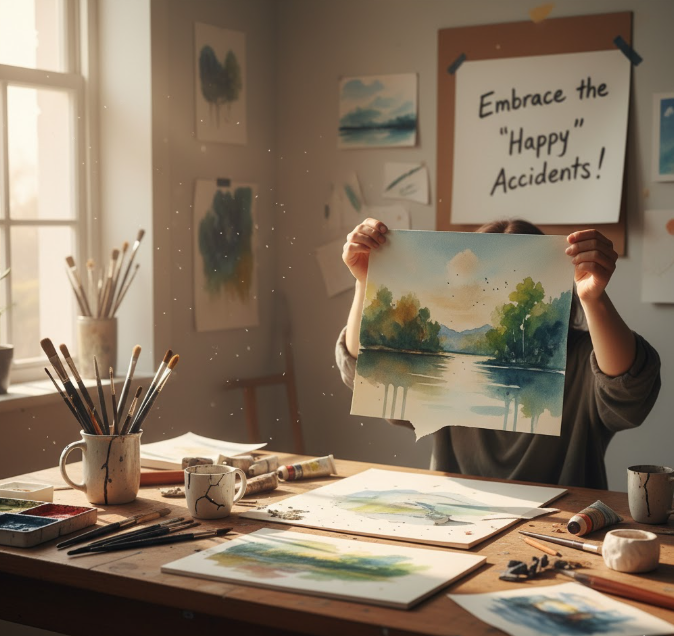
Chart: Creative Growth Over Time
Below is a simple conceptual chart showing how embracing imperfection leads to faster artistic growth:
Artists who embrace imperfection learn faster, explore more, and reach higher levels of creativity sooner than those stuck chasing perfection.
The Mindset Shift: From Judgment to Curiosity
Instead of thinking “I messed up,” try asking:
-
“What can I learn from this?”
-
“How does this change my composition?”
-
“Could this mistake become the best part?”
Curiosity turns frustration into fascination. It keeps you exploring instead of quitting.
Everyday Exercises to Train Imperfection Acceptance
| Exercise | Purpose | Duration |
|---|---|---|
| One-Line Drawing | Builds flow and confidence | 5 minutes daily |
| Paint with Wrong Hand | Breaks control habits | 10 minutes |
| Random Color Challenge | Encourages risk-taking | 15 minutes |
| Art Swap | Let a friend add to your art | 20 minutes |
| Spontaneous Collage | Teaches composition from chaos | 30 minutes |
These fun challenges rewire your brain to see imperfection as opportunity, not error.
Embracing Imperfection Beyond the Canvas
The mindset of embracing imperfection doesn’t just improve your art—it transforms your life.
-
You stop comparing yourself to others.
-
You learn to appreciate your progress.
-
You become more resilient and open-minded.
In a way, embracing imperfection in art trains you to accept yourself—flaws, mistakes, and all.
“The more I let go of perfection in my art, the more peace I found in my life.”
Conclusion: The Art of Being Perfectly Imperfect
Every artist’s journey is filled with smudges, spills, and setbacks. But that’s what makes it beautiful. The true masterpiece isn’t the one without flaws—it’s the one filled with honesty, emotion, and courage.
When you embrace imperfection, you free yourself from fear. You rediscover the reason you started creating in the first place—not to be perfect, but to express, feel, and connect.
So next time your paint drips or your pencil slips, smile. You’re not making a mistake—you’re making art.