
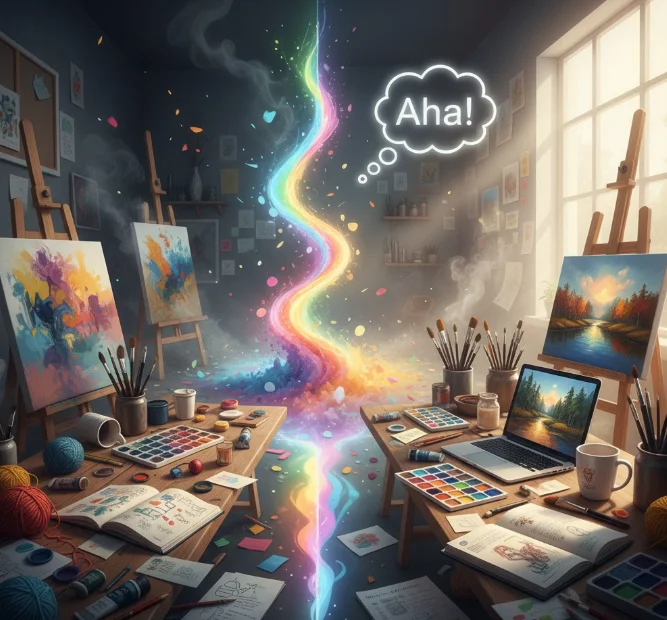
Introduction: When Creativity Feels Like a Storm
If you’ve ever sat in front of a blank page with a thousand ideas buzzing in your mind, you know what creative chaos feels like. It’s that strange mix of excitement and confusion — where inspiration flows faster than you can organize it. You have a vision, but it’s tangled in unfinished sketches, half-written ideas, and mental clutter.
The truth is, creativity rarely starts in order. It’s wild, unpredictable, and often messy. But within that chaos lies pure magic — if you know how to shape it. Turning creative chaos into clarity isn’t about suppressing your imagination. It’s about learning how to manage, focus, and channel it into something powerful, consistent, and deeply fulfilling.
In this ultimate guide, we’ll explore how to take your whirlwind of creative energy and transform it into clear direction, productivity, and peace of mind — without losing that spark that makes your creativity unique.
H2: What Is Creative Chaos and Why It’s Actually a Good Thing
Before we talk about clarity, let’s break one big myth: creative chaos isn’t bad.
Many artists, writers, designers, and thinkers often believe they need a perfectly organized space or a strict routine to be productive. But the truth is, chaos is part of the creative process. It’s where innovation and imagination collide.
Signs You’re in Creative Chaos
-
You start multiple projects but finish few.
-
Your workspace is full of sketches, notes, or random ideas.
-
You often feel overwhelmed by too many creative possibilities.
-
You jump from one idea to another without a clear plan.
-
You get sudden bursts of inspiration followed by burnout.
These signs don’t mean you’re unorganized — they mean your creative brain is highly active. Chaos becomes a problem only when it blocks progress. The goal isn’t to silence chaos, but to shape it into clarity.
H2: Why Clarity Matters for Every Creative Mind
Clarity is like a compass. Without it, even the most talented creator can lose direction. When you have clarity, you understand your purpose, know your next step, and feel confident in your creative flow.
Benefits of Creative Clarity
| Benefit | Description |
|---|---|
| Focus | Helps you identify what really matters and ignore distractions. |
| Productivity | You complete projects faster and with more consistency. |
| Confidence | You stop doubting your ideas and trust your creative vision. |
| Calmness | A clear mind means less anxiety and overthinking. |
| Growth | You can track your progress and improve continuously. |
Clarity doesn’t kill creativity — it gives it direction. It’s like turning random musical notes into a symphony.
H2: Step-by-Step Plan to Turn Chaos into Creative Clarity
Let’s break the transformation process into seven practical steps that anyone — from artists and writers to entrepreneurs — can follow.
Step 1: Capture Everything — Don’t Let Ideas Float Away
Your brain is not a storage device; it’s a creation machine. When ideas stay in your head, they clutter your thoughts and create mental chaos.
Solution: Capture every idea, no matter how small.
How to Do It:
-
Keep a notebook or digital app (like Notion, Evernote, or Google Keep).
-
Write down every thought, image, or phrase that excites you.
-
Don’t judge ideas yet — just collect them.
Pro Tip: Use a “Creative Dump” page where you can throw every raw idea before sorting it later.
This step alone can clear up half of your mental clutter because you’re not holding ideas in your brain anymore — they’re safely stored.
Step 2: Organize Ideas with Intention
Once your ideas are out of your head, it’s time to bring structure. Think of it like tidying a creative room — not throwing things away, but giving them a proper place.
How to Sort Your Ideas:
-
Group Similar Ideas
Combine related concepts under themes like “Art Projects,” “Business Ideas,” or “Writing Topics.” -
Label Each Idea’s Stage
Example:-
💡 New Idea
-
⚙️ In Progress
-
✅ Completed
-
-
Use Folders or Tags
In digital apps, use color codes or tags like “urgent,” “later,” or “research.”
When your ideas are visually organized, it becomes easier to choose what to focus on next.
Step 3: Identify Your Creative North Star
Every artist or creator needs a guiding purpose — something that connects all their work. This “North Star” gives meaning and direction to your creative journey.
Ask yourself:
-
Why do I create?
-
What message or feeling do I want to express through my work?
-
If I had to describe my creative identity in one sentence, what would it be?
Once you define this, it becomes easier to filter ideas. Anything that aligns with your North Star stays. Everything else can wait.
Example Table:
| Creative Focus | Purpose | Example Project |
|---|---|---|
| Visual Artist | Explore emotion through color and movement | Abstract series on “Energy and Silence” |
| Writer | Inspire young readers to chase dreams | Motivational short story collection |
| Designer | Simplify complex ideas through visuals | Infographic book on creativity |
Your North Star isn’t fixed; it grows with you. But always have one visible — write it on a sticky note or set it as your phone wallpaper.
Step 4: Design Your “Creative Routine” (Not a Strict Schedule)
You don’t need a rigid daily timetable. What you need is a rhythm that fits your natural creative flow.
How to Build It:
-
Find Your Peak Energy Time: Morning, afternoon, or night — create during your most energetic hours.
-
Set Mini Goals: Instead of “finish painting,” try “paint for 45 minutes.”
-
Add Break Blocks: Schedule time for rest, walks, or inspiration breaks.
Example Daily Flow Table:
| Time | Activity | Purpose |
|---|---|---|
| 8:00 – 9:00 AM | Morning journal & sketch | Free creative warm-up |
| 10:00 – 12:00 PM | Deep creative work | Focused project time |
| 12:00 – 1:00 PM | Lunch/Break | Recharge |
| 2:00 – 3:00 PM | Research or learning | Expand inspiration |
| 4:00 – 6:00 PM | Light creative edits | Gentle, structured work |
This flexible rhythm keeps chaos from sneaking in and turns creativity into a sustainable habit.
Step 5: Learn the Power of Decluttering (Physical + Digital + Mental)
Clutter can quietly drain your creative energy. Whether it’s messy files, too many tools, or even emotional stress, clutter creates invisible noise.
Three Levels of Creative Decluttering:
| Type | Examples | How to Declutter |
|---|---|---|
| Physical | Messy desk, scattered art tools | Clean workspace weekly |
| Digital | Random files, endless tabs | Organize files by project |
| Mental | Negative self-talk, comparison | Practice journaling or mindfulness |
Tip: At the end of each week, do a 15-minute “Creative Reset” — tidy your space, delete unnecessary files, and list what you’ve achieved.
This habit makes your workspace feel lighter and your mind calmer.
Step 6: Build Systems, Not Just Goals
Goals tell you what you want to do; systems help you get there consistently.
Example:
Goal — “Publish 10 new art pieces this year.”
System — “Create 1 artwork per month + review progress every week.”
Key Elements of a Creative System:
-
Templates or Checklists: Repeatable formats for projects.
-
Weekly Reviews: Evaluate progress and adjust.
-
Accountability: Share goals with a friend or online community.
When you have systems, you don’t rely on motivation alone. You rely on structure — and that creates clarity.
Step 7: Protect Your Creative Energy
Clarity fades quickly if you let distractions, stress, or negativity take over. Protecting your energy means creating boundaries around your creativity.
Practical Ways to Do It:
-
Say “no” to projects that don’t align with your goals.
-
Limit social media scrolling — schedule it after creative time.
-
Surround yourself with people who inspire, not drain you.
-
Take digital detox days to refresh your imagination.
Remember, creativity needs rest as much as it needs action.
H2: Tools That Help You Organize Creative Chaos
Here’s a list of useful tools and techniques that can help bring order to your creativity:
| Category | Tools/Apps | Best For |
|---|---|---|
| Idea Capture | Notion, Evernote, Google Keep | Storing thoughts and sketches |
| Task Management | Trello, ClickUp, Todoist | Tracking projects and deadlines |
| Mind Mapping | Miro, XMind | Visualizing ideas and connections |
| Time Management | Pomofocus, Toggl | Structuring work sessions |
| Inspiration Storage | Pinterest, Milanote | Saving visual ideas |
| Focus Boosters | Brain.fm, Forest App | Staying concentrated during work |
Use what fits your style — the best tool is the one you actually use.
H2: Visualizing Clarity — The Creative Funnel
To make things easier, here’s a simple infographic-style breakdown of how creative chaos turns into clarity:
| Stage | Description | Outcome |
|---|---|---|
| Chaos | Raw, scattered ideas | Overwhelm |
| Collection | Capture all ideas in one place | Relief |
| Organization | Sort and categorize ideas | Focus |
| Direction | Identify purpose and main goal | Clarity |
| Execution | Follow systems and routines | Productivity |
| Reflection | Review and improve | Growth |
This process repeats in cycles — every time you complete one creative project, you evolve into the next level of clarity.
H2: How to Stay Consistent When Chaos Returns
No matter how clear you get, chaos will return. It’s natural. The secret is consistency in clarity practices.
Here’s how to handle it:
-
Pause Before Panic: When overwhelmed, stop and breathe.
-
Return to Your Capture Habit: Write or record new ideas immediately.
-
Review Your North Star: Remind yourself why you started.
-
Simplify Your Next Step: Focus on one task, not the whole mountain.
-
Celebrate Progress: Every small win deserves recognition.
Consistency transforms clarity from a one-time success into a lifelong creative strength.
H2: Real-Life Examples of Turning Chaos into Clarity
Let’s look at how famous creators managed their chaos:
| Creator | Chaos Source | Clarity Method |
|---|---|---|
| Leonardo da Vinci | Dozens of unfinished projects | Used detailed notebooks to record and refine ideas |
| Maya Angelou | Emotional overload from experiences | Wrote every morning to channel emotions into words |
| Steve Jobs | Overflow of innovative ideas | Focused on simplicity and minimalism in design |
| Frida Kahlo | Physical pain and turmoil | Expressed clarity through visual symbolism in her art |
These examples show that clarity doesn’t erase chaos — it transforms it into brilliance.
H2: Quick Creative Clarity Checklist
Here’s a simple checklist to help you apply everything in this guide:
✅ Capture all your ideas in one place
✅ Group and label them for organization
✅ Define your creative North Star
✅ Design a natural daily creative routine
✅ Declutter your space, mind, and files weekly
✅ Build systems for progress tracking
✅ Protect your creative time and energy
✅ Review your goals and celebrate wins
Keep this checklist visible near your workspace — it’s your creative compass.
Conclusion: From Chaos to Creative Mastery
Creativity was never meant to be perfectly neat. It’s meant to be alive — full of energy, curiosity, and yes, a bit of chaos. But when you learn how to capture, organize, and direct that chaos, something magical happens: you gain clarity with momentum.
You stop chasing random sparks and start building meaningful fires. You stop doubting your ideas and begin trusting your process.
Remember, clarity isn’t about perfection — it’s about progress. Every sketch, every mistake, every brainstorm brings you closer to your best creative self.
So embrace the chaos, shape it with structure, and let your creativity shine through clarity — every single day.