

Introduction: When Creativity Feels Out of Reach
Every artist, whether a painter, writer, musician, or designer, knows that creativity isn’t always on call. There are days when the canvas feels blank not just on the outside—but inside your mind too. You stare, think, and wait… but nothing comes.
Here’s the truth: inspiration isn’t something you wait for—it’s something you build daily.
The most successful and consistent artists aren’t magically inspired all the time; they’ve developed practical ways to stay connected to creativity. This article reveals 7 proven techniques that can help you ignite artistic inspiration every single day, no matter what your medium or style is.
1. Create a Daily Artistic Routine
Routine may sound boring, but it’s actually the foundation of creativity.
When you work on your art at the same time each day, you train your brain to expect creative activity, which helps ideas flow naturally.
Why Routine Boosts Creativity
Consistency builds discipline: You don’t have to “feel inspired” to start creating.
Reduces decision fatigue: Your mind focuses on the art, not on when to begin.
Creates mental triggers: Like Pavlov’s dog, your brain associates certain times or settings with creativity.
How to Build Your Routine
Pick a creative hour: Choose a time when you feel most alert—morning or night.
Set a space: Even a small corner can become your “studio.”
Start small: Begin with 15–20 minutes daily and increase gradually.
Protect the time: Treat it like an appointment—non-negotiable.
💡 Pro Tip: Use a creativity tracker or a habit journal to measure your daily art streaks. Visual progress often motivates consistency.
2. Surround Yourself with Inspiring Environments
Your environment directly influences your imagination. Messy or uninspiring surroundings can block creativity, while fresh, inspiring spaces spark new ideas.
Transform Your Space for Creativity
Here’s a quick visual table to help you design a creativity-friendly environment:
| Element | What to Do | Why It Helps |
|---|---|---|
| Lighting | Use warm natural light or adjustable lamps | Enhances mood and energy |
| Colors | Add pops of colors that evoke emotion (e.g., blue = calm, yellow = energy) | Affects emotional tone of your art |
| Music | Play instrumental or ambient soundtracks | Stimulates imagination |
| Scent | Use candles, incense, or essential oils | Creates sensory connection to creativity |
| Visual Inspiration | Display art prints, quotes, or your previous works | Keeps motivation alive |
Take Your Creativity Outdoors
When indoor spaces feel stale:
Visit a park, museum, or café with your sketchbook.
Observe textures, people, and light.
Try “plein air” sketching or digital journaling outside.
Sometimes, changing your surroundings changes everything.
3. Experiment with New Mediums and Tools
Repetition can dull your creative spark. If you keep using the same tools and methods, your brain goes on autopilot.
Exploring something unfamiliar rekindles curiosity and opens new creative pathways.
Ideas to Break the Routine
If you’re a painter, try digital illustration or collage art.
If you’re a writer, explore poetry, song lyrics, or visual storytelling.
If you’re a musician, experiment with different instruments or genres.
If you’re a photographer, shoot using film or try night photography.
Creative Experimentation Plan
| Week | Experiment | Goal |
|---|---|---|
| 1 | Try a new medium | Discover new creative flow |
| 2 | Change your subject or style | Break predictability |
| 3 | Collaborate with another artist | Learn from new perspectives |
| 4 | Reflect on what felt most natural | Identify new directions |
🎨 Tip: Keep an “Art Experiment Journal” where you note what excites you about each new method. Reflection helps you see progress and stay inspired.
4. Keep an Inspiration Journal or Mood Board
Inspiration doesn’t always strike at convenient times—but it does strike.
Capturing it in the moment ensures you never lose a spark again.
What to Record in Your Inspiration Journal
Random ideas or sketches
Colors or patterns that catch your eye
Lyrics, poems, or phrases that evoke emotion
Dreams or recurring thoughts
Photos, textures, or materials that stand out
You can do this digitally (using apps like Notion, Pinterest, or Evernote) or physically in a notebook.
Create a Mood Board
A mood board helps visualize your creative goals. It’s like a map of your artistic imagination.
Include:
Color palettes
Magazine clippings or digital photos
Typography and shapes
Inspirational quotes
💭 Pro Tip: Refresh your mood board every month. Keep it evolving with your creative growth.
5. Collaborate and Connect with Other Artists
Art thrives in connection. Working with others exposes you to fresh techniques, perspectives, and motivation.
Benefits of Collaboration
Shared energy: Other artists inspire you when your motivation dips.
Skill exchange: You learn new tricks or styles.
Accountability: You stay productive because someone’s counting on you.
Expanded audience: Collaborations help reach new followers or art communities.
Ways to Collaborate
Joint art projects: Paint, record, or design together.
Online challenges: Join social media art prompts like Inktober or Draw This in Your Style.
Local art clubs or workshops: Network in person and learn from peers.
Creative swaps: Exchange unfinished works and complete each other’s pieces.
| Collaboration Type | How It Helps |
|---|---|
| Art Swaps | Builds trust and sparks new styles |
| Group Challenges | Encourages consistency |
| Critique Circles | Provides constructive feedback |
| Exhibitions or Events | Increases exposure and motivation |
🤝 Pro Tip: Even virtual collaboration (like Discord art communities or Reddit groups) keeps the creative fire alive.
6. Step Away to Recharge Your Creative Energy
Creativity doesn’t always mean doing more. Sometimes, stepping back helps ideas bloom naturally.
When your mind is overloaded, it blocks imagination. Resting gives it space to reorganize and reconnect with curiosity.
How to Rest Creatively
Go for a walk: Observe shapes, shadows, and sounds.
Listen to music: Let rhythm spark visual ideas.
Meditate or breathe deeply: Calm your mind before diving back into art.
Engage in hobbies: Gardening, reading, or cooking can inspire indirectly.
Sleep well: Many artists (like Salvador Dalí) got their best ideas after short naps.
The Science Behind Rest
According to neuroscience studies, when you take breaks:
Your default mode network (DMN) becomes active, which helps form creative connections.
Your stress levels decrease, letting your brain think freely.
You return to your art refreshed, not frustrated.
🌿 Pro Tip: Treat rest as part of your creative schedule, not as a guilty pleasure.
7. Set Creative Goals and Reflect Regularly
Without direction, even inspiration can scatter. Setting clear creative goals gives your imagination a purpose.
SMART Creative Goals
Use the SMART formula to design goals that actually motivate you:
Specific: “I’ll sketch one portrait per day.”
Measurable: “I’ll complete 10 mini paintings this month.”
Achievable: “I’ll try one new technique per week.”
Relevant: “This aligns with my personal art style.”
Time-bound: “I’ll finish my series by December.”
Track Your Progress
| Goal | Timeline | Status | Reflection |
|---|---|---|---|
| 5 nature sketches | 1 week | ✅ Done | Improved observation skills |
| Try watercolor blending | 3 days | 🔄 Ongoing | Need to refine brush control |
| Attend art meetup | 2 weeks | ❌ Missed | Reschedule next month |
Reflect to Reconnect
At the end of each week:
Review what you created.
Note what inspired you most.
Ask: What did I enjoy most? What felt forced?
📘 Pro Tip: Reflection keeps your creativity grounded in purpose rather than pressure.
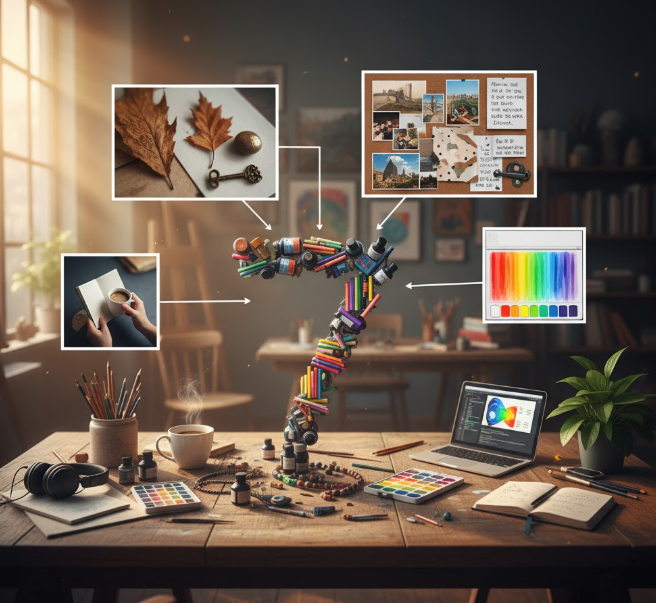
Bonus: Turn Everyday Life into Art
Art isn’t just made in studios—it’s hidden in daily life. You just have to look closer.
How to Find Inspiration in the Ordinary
Watch the shadows move during sunset.
Notice color combinations in street signs or fabrics.
Capture expressions of people at a café.
Listen to the rhythm of conversations around you.
Collect textures—pebbles, leaves, paper scraps—and recreate them.
Creative Challenge: “The Daily Muse”
Try this for a week:
Pick one random object from your day (e.g., a spoon, a cloud, a shoe).
Create something inspired by it—draw, write, photograph, or sing.
Post or store it in your inspiration journal.
✨ Over time, this trains your brain to find art everywhere.
Infographic: Daily Creativity Blueprint
Here’s a simple visual routine you can follow:
| Time of Day | Action | Purpose |
|---|---|---|
| Morning | 10-minute sketch or doodle | Warm up creativity |
| Midday | Short walk or playlist session | Refresh your senses |
| Evening | Reflect and note new ideas | Capture inspiration for tomorrow |
| Weekend | Try new tools or collaboration | Keep learning and exploring |
(Imagine this as a circular “Creativity Cycle” infographic—morning to night inspiration flow.)
SEO Keywords Used Naturally:
artistic inspiration, creative motivation, daily art routine, art challenges, mood board ideas, art collaboration, creativity tips, how to stay inspired as an artist, spark creativity, creative energy, art journaling, creative habits
Conclusion: Keep the Spark Alive Every Day
Inspiration isn’t lightning—it’s a steady flame. You don’t have to wait for the “perfect moment” to feel creative. You build that moment by showing up, experimenting, connecting, and allowing yourself to rest.
By practicing these 7 proven techniques—from creating daily routines to embracing collaboration—you’ll find that artistic inspiration starts showing up more often, more naturally, and more powerfully.
Remember: your creativity is not a rare gift; it’s a renewable source. Feed it, protect it, and express it daily—and your art will keep growing with you.